Coverage
This page maps supported emitter families to the real radio-frequency (RF) bands they usually occupy and summarizes how synthetic outputs are compared with real captures. Use it when scoping a study, choosing families that can plausibly coexist in one scene, or planning sim-to-real validation.
Spectrum coverage: which RF bands and protocols the supported emitter families occupy in practice.
Validation methodology: how synthesized waveforms are compared to over-the-air captures.
Neither question is essential to understanding what an emitter is. For the emitter contract and instantiation pattern, start with the emitters concept page and its minimal worked example.
Spectrum coverage
The map below shows where each family typically operates. The horizontal axis is logarithmic, so each equal step represents a frequency ratio rather than a fixed number of hertz. This makes narrow low-frequency bands and wide millimeter-wave ranges visible in the same figure.
Carrier-agnostic generation means the emitter produces clean baseband in-phase/quadrature (IQ) and does not choose its absolute transmit (TX) frequency. The scene composer places the emitted signal in scene-relative time and frequency coordinates, and propagation backends receive the resolved scene and emitter frequency metadata they need. The map exists so researchers can see which families plausibly coexist in a given band.
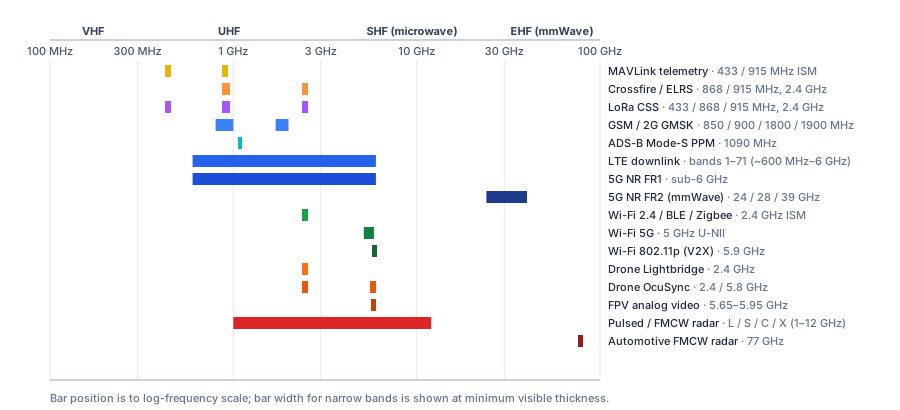
Source: the cellular ranges follow 3rd Generation Partnership Project (3GPP) Long-Term Evolution (LTE) and 5G New Radio (NR) operating-band tables (TS 36.101, TS 38.101-1, and TS 38.101-2). Wi-Fi, Bluetooth Low Energy (BLE), Zigbee, and sub-GHz industrial, scientific, and medical (ISM) examples follow the Federal Communications Commission (FCC) online allocation table and the IEEE 802.11 / 802.15.4 standard families. LoRa examples follow the LoRa Alliance regional-parameters specification. Automatic Dependent Surveillance-Broadcast (ADS-B) uses the FAA-documented 1090 MHz and 978 MHz links. Treat the graphic as a planning aid, not as a regulatory compliance table.
Validation methodology
The citeable references for synth-vs-real validation are RF machine-learning benchmark datasets that compare generated or simulated waveforms against classification behavior on held-out data. rfgen uses the TorchSig Sig53 paradigm as a precedent [1]:
Sig53 (5M samples, 53 classes, on-the-fly generation): documents synthetic-with-impairments methodology with on-the-fly creation at training time enabling virtually unlimited datasets.
Beyond classifier-accuracy comparison, two validation suites remain open research questions. Cyclostationary-signature checks would compare repeating statistical structure in a waveform. Spectral-mask-compliance checks would compare frequency-domain energy against protocol or regulatory limits. Both need a future research pass before they become framework contracts.
The planned hardware-in-the-loop (HIL) validation harness applies comparable checks on a 1K-sample subset. A cabled path connects software-defined-radio devices, such as USRP or HackRF hardware, directly for a controlled baseline; an over-the-air path transmits and receives through real antennas. See Background / Validation for the harness, the metrics, and the pass thresholds.
See Also
Library landscape for the per-family backend choices that drive this coverage.
Background / Validation for the HIL harness and sim2real metrics.
References
Boegner, L. et al. Large Scale Radio Frequency Signal Classification. https://arxiv.org/abs/2207.09918
O’Shea, T., Corgan, J., and Clancy, T. Convolutional Radio Modulation Recognition Networks. https://arxiv.org/abs/1602.04105; O’Shea, T., Roy, T., and Clancy, T. Over-the-Air Deep Learning Based Radio Signal Classification. https://arxiv.org/abs/1712.04578
3GPP. TS 36.101: E-UTRA UE radio transmission and reception. https://www.3gpp.org/DynaReport/36101.htm
3GPP. TS 38.101-1: NR UE radio transmission and reception, Range 1. https://www.3gpp.org/DynaReport/38101-1.htm
3GPP. TS 38.101-2: NR UE radio transmission and reception, Range 2. https://www.3gpp.org/DynaReport/38101-2.htm
FCC. Online Table of Frequency Allocations. https://www.fcc.gov/oet/spectrum/table/fcctable.pdf
LoRa Alliance. LoRaWAN Regional Parameters. https://resources.lora-alliance.org/technical-specifications/lorawan-regional-parameters-v1-0-3reva
FAA. ADS-B In and Out. https://www.faa.gov/air_traffic/technology/equipadsb/capabilities/ins_outs