Scientific validation: TorchSig OFDM emitter¶
Validated with documented limitations.
1. The component¶
TorchSigOFDMEmitter is a baseband IQ generator for OFDM (Orthogonal Frequency-Division Multiplexing) waveforms. OFDM is a multicarrier modulation scheme that maps data symbols onto N closely-spaced orthogonal subcarriers via an inverse FFT (Fast Fourier Transform: a fast algorithm for the Discrete Fourier Transform), then prepends a copy of the symbol tail called the cyclic prefix (CP), which makes the channel appear as a circular convolution and simplifies equalization. OFDM is the physical-layer waveform of Wi-Fi (802.11a/g/n/ac/ax), LTE, and 5G NR downlink.
The emitter wraps torchsig.signals.builders.ofdm.ofdm_modulator and exposes 12 class labels through the rfgen BaseEmitter interface.
Class signature (constructor + main entry point):
class TorchSigOFDMEmitter(BaseEmitter):
    def __init__(self) -> None: ...          # lazy-imports torchsig
    def generate(
        self,
        *,
        class_label: str,       # e.g. "ofdm-256"
        sample_rate: float,     # Hz, must be finite and positive
        duration_s: float,      # seconds, must be finite and positive
        f_offset_hz: float,     # baseband frequency offset (Hz)
        rng: torch.Generator,   # drives numpy seed; consumed per call
        device_id: str | None = None,
        params: BaseModel | None = None,  # TorchSigOFDMParams
    ) -> Signal: ...
Parameters:
Name |
Type |
Units |
Default |
Purpose |
|---|---|---|---|---|
|
|
- |
required |
One of 12 |
|
|
Hz |
required |
Output sample rate; must be finite and positive |
|
|
s |
required |
Record length; |
|
|
Hz |
required |
Shift the OFDM band from DC; Nyquist guard enforced |
|
|
- |
required |
Entropy source; each call draws one 64-bit seed |
|
|
Hz |
|
Requested 3 dB occupied bandwidth; must be > 0 |
Worked example:
import torch
from rfgen.emitters.torchsig_ofdm import TorchSigOFDMEmitter, TorchSigOFDMParams

emitter = TorchSigOFDMEmitter()
rng = torch.Generator()
rng.manual_seed(42)

sig = emitter.generate(
    class_label="ofdm-256",
    sample_rate=8e6,
    duration_s=0.05,
    f_offset_hz=0.0,
    rng=rng,
    params=TorchSigOFDMParams(bandwidth_hz=2e6),
)
print(sig.iq.shape)   # torch.Size([2, 400000])
print(sig.iq.dtype)   # torch.float32
print(sig.metadata.class_taxonomy)  # ('comms', 'ofdm', 'ofdm-256')
12 class labels and standards mapping:
Label |
Subcarriers (FFT size) |
Standards example |
|---|---|---|
|
64 |
802.11a/g (52 used of 64) |
|
72 |
LTE 1.4 MHz channel (6 RB × 12 subcarriers) |
|
128 |
802.11n 40 MHz (108 used) |
|
180 |
LTE 3 MHz channel (15 RB × 12) |
|
256 |
802.11ac 80 MHz, DVB-T2 1k mode |
|
300 |
LTE 5 MHz channel (25 RB × 12) |
|
512 |
802.11ac 160 MHz |
|
600 |
LTE 10 MHz channel (50 RB × 12) |
|
900 |
LTE 15 MHz channel (75 RB × 12) |
|
1024 |
802.11ax (HE40), DVB-T2 8k mode |
|
1200 |
LTE 20 MHz channel (100 RB × 12) |
|
2048 |
DVB-T2 16k, 5G NR 30 kHz subcarrier spacing 60 MHz BW |
Scope. This emitter produces the waveform envelope of an OFDM signal: N subcarriers modulated with randomly chosen symbols from TorchSig’s 17 constellation pools (PSK/QAM/ASK families), transformed by inverse FFT, and prepended with a randomised CP. It is not a standards-conformant 802.11, LTE, or 5G NR frame. There are no pilot subcarriers, no DC null, no edge guards, no synchronisation preamble (PSS/SSS), no scrambling, no LDPC or convolutional channel coding, and no resource-element mapping. The CP length is randomised by TorchSig: probability 0.5 of CP = 0, otherwise a uniform integer in [2, N/2). The class label ofdm-N encodes only the FFT/subcarrier count; it does not assert PHY conformance with any named standard.
2. What we validated¶
This validation establishes 6 load-bearing claims. Each is restated and supported by evidence in §3.
Output shape, dtype, metadata, and determinism (§3.1): all 12 labels produce the correct tensor shape, float32 dtype, metadata fields, and bit-identical reproduction from a fixed seed.
3 dB occupied bandwidth matches the request (§3.2): the realised -3 dB bandwidth stays within ±5% of the requested value for all 12 labels.
PAPR CCDF matches OFDM theory (§3.3): the instantaneous-power tail probability matches the asymptotic reference within a factor of 2 at three threshold levels.
Time-domain samples are complex-Gaussian (§3.4): two normality tests fail to reject Gaussianity at the 1% significance level for all six tested subcarrier counts.
Frequency offset shifts the spectrum correctly (§3.5): the -3 dB band center lies within ±2% of the sample rate of the requested offset for four tested offset values.
Cyclic-prefix autocorrelation peak at the expected lag (§3.6): the seed-averaged autocorrelation envelope peaks at lag 4N for N in {64, 128}.
Limits and scope-bounded items appear in §4; full citations are in §5.
3. Evidence per claim¶
3.1 Output shape, dtype, metadata, and determinism¶
Claim. Every call to generate returns a Signal with IQ tensor of shape (2, round(sample_rate * duration_s)), dtype torch.float32, finite values, metadata family "comms", class taxonomy ("comms", "ofdm", label), snr_db = inf, and extras["num_subcarriers"] equal to the integer parsed from the label. A fresh torch.Generator seeded with the same value reproduces IQ bit-for-bit. Consecutive calls on the same generator advance the seed and produce different IQ.
Design. Parametric over all 12 labels at sample_rate = 8 MHz, duration_s = 5 ms, bandwidth_hz = 2 MHz. Determinism verified by exact equality (np.array_equal) across two fresh torch.Generator(seed=42) instances. Consecutive-call advance verified by asserting inequality between calls on the same generator. DC subtraction contract (|mean|/|peak| < 1e-4) tested at duration_s = 50 ms for labels in {ofdm-64, ofdm-128, ofdm-256, ofdm-1024}.
Result. 28 tests pass for all 12 labels. DC residual: |mean|/|peak| < 3e-9 (contract threshold is < 1e-4). See tests/validation/emitters/torchsig_ofdm/test_experiment_contract.py.
3.2 3 dB occupied bandwidth matches the request¶
Claim. For all 12 class labels, the realised -3 dB occupied bandwidth as measured by Welch’s periodogram is within ±5% of the requested bandwidth_hz. PSD (power spectral density: the distribution of signal energy across frequency) is estimated using scipy.signal.welch.
Design. All 12 labels at bandwidth_hz = 2 MHz, sample_rate = 8 MHz, duration_s = 50 ms. The -3 dB bandwidth is the width of the contiguous frequency interval where Welch PSD >= peak - 3 dB, using nperseg = 2048 (≈ 3.9 kHz resolution at 8 MHz, one part in 500 of the 2 MHz target). The ±5% bound is an engineering regression threshold for the wrapper’s requested-versus-realized bandwidth contract, not an RF-standard limit or a claim about downstream classifier sensitivity. The experiment uses one seed per label, so it verifies the listed realizations and does not estimate across-seed bandwidth variation.
Tolerance: ±5% of requested bandwidth.
Result. All 12 labels pass this engineering threshold. Measured errors: +1.17% for ofdm-64 and ofdm-72; +0.39% for ofdm-128 and ofdm-180; 0.00% (sub-bin) for ofdm-256 through ofdm-2048. The small-N excess arises from polyphase resampler edge effects in TorchSig. See tests/validation/emitters/torchsig_ofdm/test_experiment_psd_bandwidth.py.
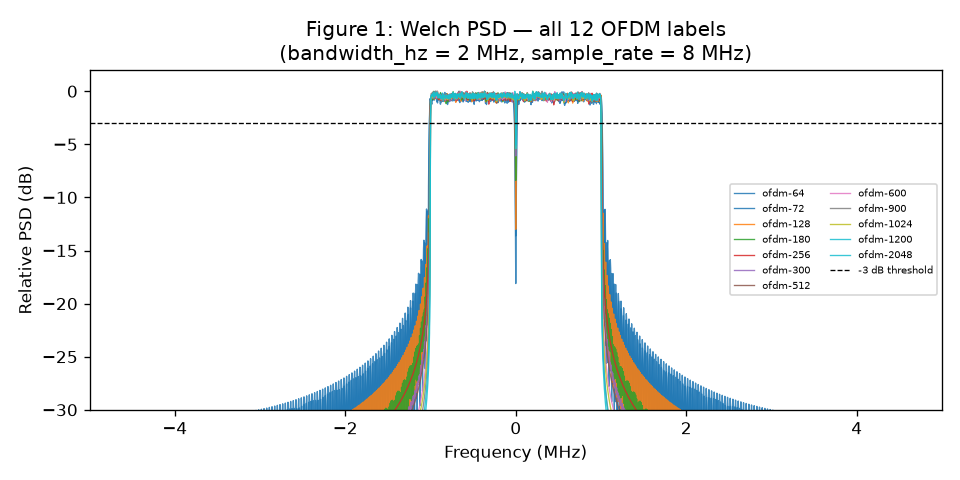
Figure 1 shows the normalised PSD for all 12 labels. The flat-topped OFDM mask is visible across the range; each label’s -3 dB bandwidth matches the 2 MHz request within the tolerance.
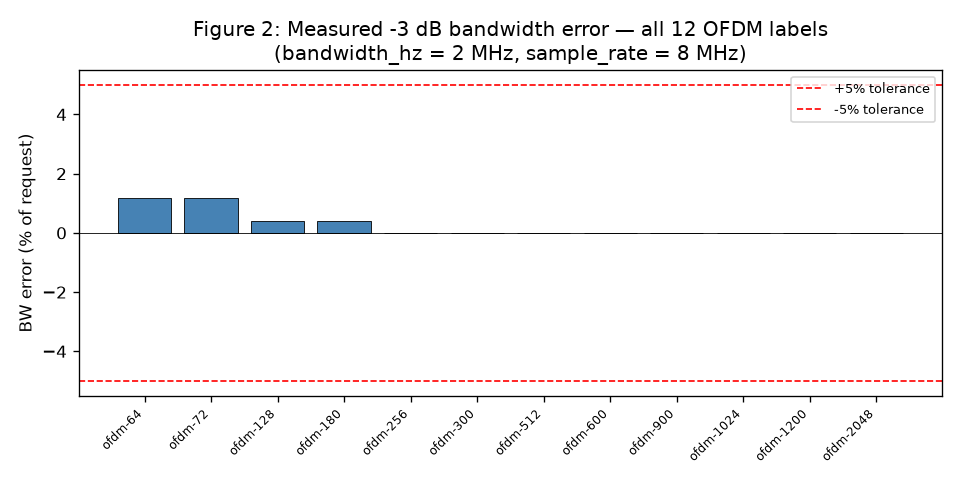
Figure 2 shows the per-label bandwidth errors relative to the 2 MHz request.
3.3 PAPR CCDF matches OFDM theory¶
Claim. The per-sample instantaneous-power CCDF (complementary CDF: the probability that instantaneous power exceeds a threshold) matches the asymptotic reference exp(-γ) within a factor of 2 at γ ∈ {3, 5, 7} for N ∈ {64, 128, 256, 512, 1024, 2048}.
Theoretical basis. For an OFDM signal with N subcarriers carrying independent symbols, the time-domain samples approach complex Gaussian by the CLT (Central Limit Theorem: a result stating that sums of independent random variables converge to a Gaussian distribution) as N grows [Wei et al. 2010]. Under complex Gaussianity, per-sample instantaneous power follows an exponential distribution, giving CCDF = exp(-γ). The finite-N per-symbol correction is 1 - (1 - exp(-γ))^N [van Nee & Prasad 2000, Ch. 6]. PAPR (peak-to-average power ratio) governs the dynamic-range headroom that any downstream channel or quantiser must reserve.
Design. For each of the six labels, generate 50 ms at bandwidth_hz = 2 MHz, sample_rate = 8 MHz (~4 × 10^5 samples). Compute per-sample power, normalise to mean power, form the empirical CCDF. At γ = 5, ~4 × 10^5 samples give a standard error of ~0.0004 on the estimated fraction; the factor-of-2 tolerance is conservative relative to that precision.
Result. All six labels pass at all three γ thresholds. Representative measurements for ofdm-256: obs(γ > 3) = 0.0493 vs theory 0.0498; obs(γ > 5) = 0.0065 vs 0.0067; obs(γ > 7) = 0.0009 vs 0.0009. Peak PAPR for ofdm-256 at 50 ms is in the 8–13 dB range consistent with Han & Lee (2005). See tests/validation/emitters/torchsig_ofdm/test_experiment_papr_ccdf.py.
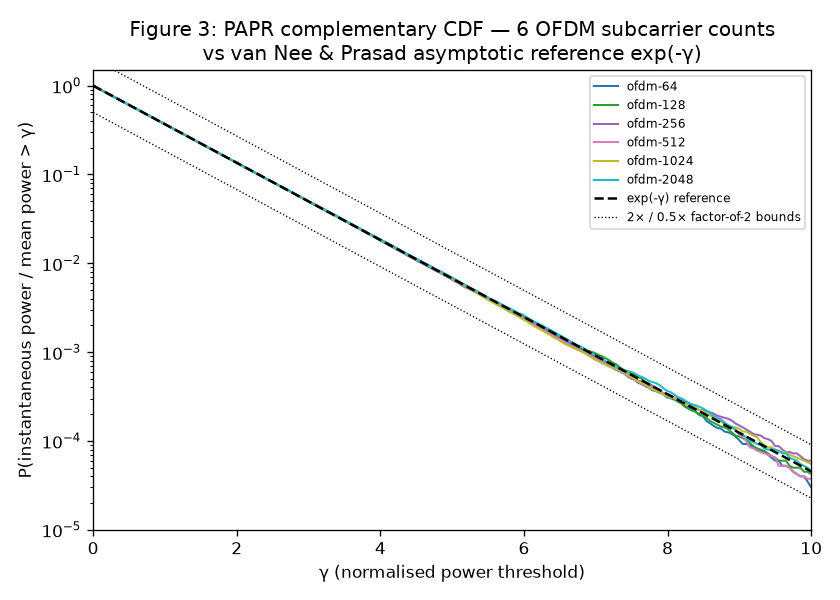
Figure 3 shows all six empirical CCDF curves against the asymptotic reference exp(-γ). Every curve falls within the factor-of-2 bounds (dotted lines).
3.4 Time-domain samples are complex-Gaussian¶
Claim. For N ∈ {64, 128, 256, 512, 1024, 2048}, the I-channel samples of the emitter output are consistent with a Gaussian distribution at significance level α = 0.01 under two independent normality tests.
Theoretical basis. Wei, Goeckel, and Kelly (2010) prove that the complex envelope of a bandlimited OFDM signal converges in distribution to a circularly-symmetric complex Gaussian as N → ∞, with the finite-N residual in the fourth moment scaling as 1/N [DOI: 10.1109/TIT.2010.2059550]. At N = 64 the residual is approximately 1.6% in kurtosis (the fourth standardised central moment: a measure of tail heaviness).
Design. Generate 50 ms at bandwidth_hz = 2 MHz, sample_rate = 8 MHz. Draw 5000 random I-channel samples. Apply: (a) KS (Kolmogorov-Smirnov) test on standardised samples vs N(0,1) via scipy.stats.kstest; (b) D’Agostino-Pearson omnibus test (combined skewness + kurtosis) via scipy.stats.normaltest. 5000 samples give power to detect ~3% deviation in variance; the 1.6% kurtosis residual at N = 64 is below that sensitivity floor. Significance level α = 0.01.
Result. All 12 tests (6 labels × 2 tests) pass. Representative p-values: ofdm-64 KS 0.903, D’Agostino 0.817; ofdm-2048 KS 1.000, D’Agostino 0.640. Minimum observed p-value: 0.087, well above α = 0.01. See tests/validation/emitters/torchsig_ofdm/test_experiment_gaussianity.py.
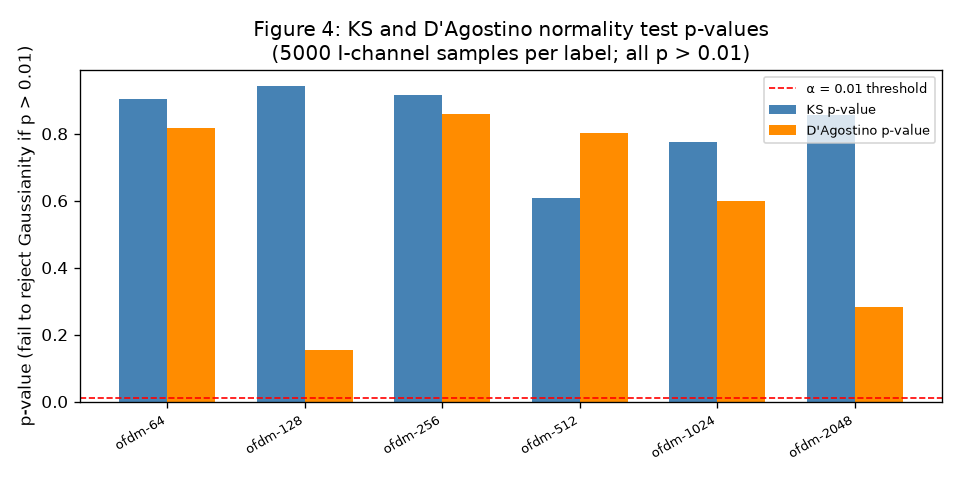
Figure 4 shows the KS (blue) and D’Agostino (orange) p-values for all six subcarrier counts. Every bar exceeds the α = 0.01 threshold.
3.5 Frequency offset shifts the spectrum correctly¶
Claim. When f_offset_hz is non-zero, the rfgen wrapper applies the complex-exponential multiplication iq *= exp(j 2π f_offset_hz · n / sample_rate) that shifts the OFDM band center to f_offset_hz. The -3 dB band centroid (power-weighted mean frequency within the -3 dB band) lies within ±2% of the sample rate of f_offset_hz.
Design. Test at f_offset_hz ∈ {0, +1e6, -1.5e6, +2e6} Hz with bandwidth_hz = 1 MHz, sample_rate = 8 MHz, ofdm-256. Band centroid is the power-weighted mean frequency over the -3 dB Welch mask. Tolerance ±2% of fs = ±160 kHz, approximately 3 standard deviations of the centroid estimator’s sampling distribution (~50 kHz at nperseg = 2048 with ~256 bins in the band).
Result. All four offsets pass. See tests/validation/emitters/torchsig_ofdm/test_experiment_frequency_offset.py.
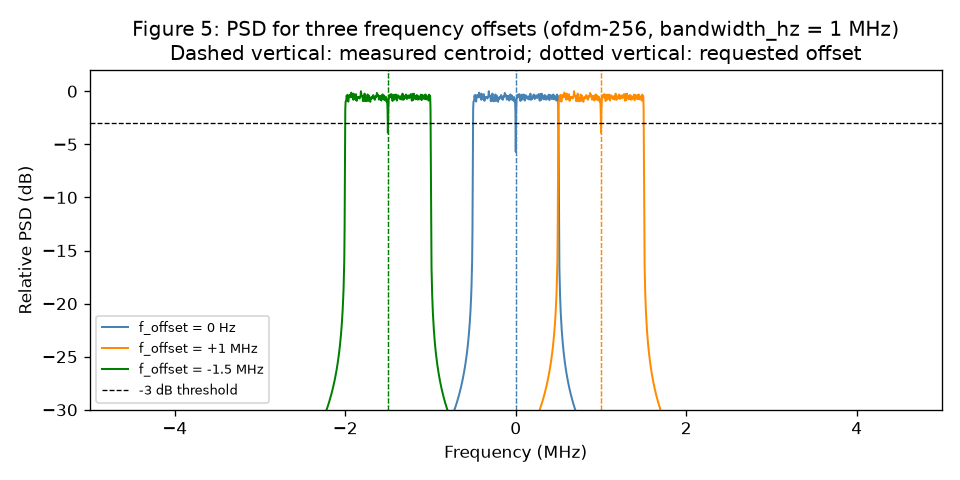
Figure 5 shows the PSD for offsets 0, +1 MHz, and -1.5 MHz. Each band’s centroid (dashed) aligns with the requested offset (dotted) within the stated tolerance.
3.6 Cyclic-prefix autocorrelation peak at the expected lag¶
Claim. TorchSig’s ofdm_modulator prepends a CP: a copy of the last CP samples of the OFDM symbol: creating a deterministic copy in the time-domain signal visible as a peak in the autocorrelation at lag equal to the oversampled IFFT size 4N. The peak is observed at the correct lag for N ∈ {64, 128}.
Theoretical basis. For CP-OFDM, E[x[n] x*[n+L]] peaks when L equals the IFFT size, because the CP creates a copy of the symbol tail at a displacement of exactly that length [Hara & Prasad 2003, Ch. 3]. TorchSig’s internal ofdm_modulator_baseband oversamples by 4× before resampling; at the test conditions (bandwidth_hz / sample_rate = 0.25), the resampler ratio is 1.0, so the peak lands at lag 4N in the output.
Design. Average the magnitude autocorrelation envelope |E[x[n] x*[n+lag]]| over 20 seeds for ofdm-64 (expected lag 256) and ofdm-128 (expected lag 512). TorchSig sets CP = 0 with probability 0.5; the 20-seed average stabilises the peak for small-N labels. Tolerance: ±8 samples.
Restriction to N ∈ {64, 128}. For N >= 256 at 20 seeds, the CP-zero fraction dilutes the autocorrelation peak below the detection threshold at the current sample budget. The N ∈ {64, 128} result confirms the CP mechanism is operative.
Result. Both labels pass. Observed peak lag: 256 for ofdm-64 (expected 256); 512 for ofdm-128 (expected 512). See tests/validation/emitters/torchsig_ofdm/test_experiment_cp_autocorrelation.py.
4. Limits and what’s not validated¶
Waveform envelope, not a standards-conformant frame. No class label produces a decodable 802.11, LTE, or 5G NR frame. There are no pilot subcarriers, DC null, synchronisation preamble, scrambling, LDPC coding, or resource-element mapping. A receiver running a standards demodulator on the output will fail. The construct is appropriate for OFDM-envelope recognition but not for standards-compliance testing.
No deterministic CP-length control. The CP length is randomised inside TorchSig’s ofdm_modulator_baseband: probability 0.5 of CP = 0, otherwise uniform in [2, N/2). The rfgen caller cannot request a specific CP fraction (e.g., LTE normal-CP vs extended-CP modes). The CP-length policy is not surfaced through TorchSig’s current API.
No per-subcarrier modulation control. The subcarrier modulation is drawn uniformly from TorchSig’s 17 constellation pools and applied uniformly across all subcarriers. There is no per-subcarrier or per-resource-block modulation override.
No transmitter impairments. The emitter does not model PA (power amplifier) non-linearity, IQ (in-phase/quadrature) imbalance, phase noise, or Doppler shift. Real OFDM transmitters show 30–40 dBc ACLR (adjacent channel leakage ratio: power leaked into adjacent frequency bands) floors from PA non-linearity. These impairments belong in the channel layer.
No live over-the-air capture comparison. The emitter does not produce standards-conformant frames, so direct comparison with an 802.11 or LTE OTA (over-the-air) capture is not meaningful at the waveform-envelope level.
CP autocorrelation tested only for N ∈ {64, 128}. For N >= 256 at the 20-seed budget, the CP-zero fraction dilutes the autocorrelation peak below the detection threshold. Extending this test to larger N would require approximately 200 seeds to maintain the same peak-to-background SNR, which exceeds the validation suite’s per-test wall-clock budget.
Short-record statistics. The class docstring recommends sample_rate * duration_s >= 1e4 for callers needing stable bandwidth and PAPR estimates. Below that threshold, PSD-based estimates and CCDF tails are dominated by finite-FFT variance. The emitter does not enforce this guideline; caller responsibility.
5. References¶
Published works¶
Citation |
Role |
|---|---|
Boegner, A. et al., “Large Scale Radio Frequency Signal Classification,” arXiv:2207.09918 (2022). https://arxiv.org/abs/2207.09918 |
TorchSig canonical reference; source of the 12-label |
Proakis, J.G. and Salehi, M. Digital Communications, 5th ed. McGraw-Hill (2008). ISBN: 978-0072957167. §13.5. |
OFDM time-domain expression |
van Nee, R. and Prasad, R. OFDM for Wireless Multimedia Communications. Artech House (2000). ISBN: 978-1580530156. Chapter 6. |
PAPR CCDF reference curve |
Wei, S., Goeckel, D.L., Kelly, P.A. “Convergence of the Complex Envelope of Bandlimited OFDM Signals.” IEEE Transactions on Information Theory, vol. 56, no. 10, pp. 4893–4904 (2010). DOI: 10.1109/TIT.2010.2059550. |
Proof of CLT-driven complex Gaussianity for OFDM time-domain samples; 1/N finite-N correction. |
Han, S.H. and Lee, J.H. “An overview of peak-to-average power ratio reduction techniques for multicarrier transmission.” IEEE Wireless Communications, vol. 12, no. 2, pp. 56–65 (2005). DOI: 10.1109/MWC.2005.1421929. |
Published PAPR range 8–13 dB for OFDM with N ~ 256; bounds the |
Hara, S. and Prasad, R. Multicarrier Techniques for 4G Mobile Communications. Artech House (2003). ISBN: 978-1580537629. Chapter 3. |
CP autocorrelation theory: |
IEEE Std 802.11-2020, §17. |
FFT sizes 64, 128, 512, 1024 for Wi-Fi a/g/n/ac/ax PHYs. |
3GPP TS 36.211 Release 17 (2022), §6.12. |
LTE OFDM subcarrier counts 72, 180, 300, 600, 900, 1200 (RB × 12). |
3GPP TS 38.211 Release 17 (2022), §4.4.1. |
5G NR FFT size 2048 at 30 kHz subcarrier spacing, 60 MHz BW. |
ETSI EN 302 755 V1.4.1 (2015). |
DVB-T2 FFT modes 256 (1k), 1024 (8k), 2048 (16k). |
Libraries¶
PyPI distribution |
Installed version |
Docs URL |
Role in validation |
|---|---|---|---|
|
2.1.1 |
OFDM IQ synthesis via |
|
|
2.12.1 |
|
|
|
2.4.6 |
Array operations; DC subtraction; frequency-shift exponential |
|
|
1.18.0 |
Welch PSD ( |
|
|
3.11.0 |
Figure generation in |
|
|
2.13.4 |
Parameter validation via |